Saturday, February 27, 2016

Short Term Residential Rentals

One of the things that is sometimes forgotten about short-term residential rentals is that not only must you comply with the local zoning provisions, but you must also be sure to comply with the applicable building code regulations. Most people fail to distinguish between building regulations and zoning regulations, but they are distinctly different. One shorthand way of looking at it is that zoning regulations are designed to minimize the adverse impacts on surrounding properties, whereas the building code is designed to protect people who occupied the structure.

In zoning terms, short-term residential rentals may run afoul of a local zoning requirement which may define permanent residential use as being greater then some arbitrary time. Such as more than 30 days, more than six months, or more than a year. If the use of the property does not comply with the local zoning regulations, then the use may be enjoined, that is, prohibited altogether.

In the case of the building code, short-term residential rentals may increase the types of safety precautions which are necessary. Here in Tennessee, single-family residential occupancy does not typically require automatic fire sprinklers. Tenn. Code Ann. § 68-120-101(a)(8)(A).

The question here is whether such short term residential rentals, let’s say, less than 30 days in duration, require automatic fire sprinklers despite the limits imposed by the statute referenced above. As it turns out, the State Fire Marshal’s Office has provided some answers to these questions.

First, SFMO defines what I have called short-term residential rentals as follows:
A transient rental home (“TRH”) is a building that is a single dwelling unit providing complete independent living facilities including, but not limited to, permanent provisions for living, sleeping, eating, cooking and sanitation occupied for thirty (30) days or less. These include rental cabins, buildings offered for rent on Airbnb and similar services, yurts and similar structures.
If the TRH is three stories or less in height, 5000 or fewer square feet in size, with 12 or less occupants, automatic fire sprinklers are not required. If these requirements are not met, the transient rental home must be sprinklered.
TRHs with three (3) or less stories, less than five-thousand (5,000) gross square feet, and twelve (12) or fewer occupants shall be classified as one- and two- family dwellings subject to Tenn. Comp. R. & Regs. 0780-02-23 (One and Two Family Dwellings and Townhouses). These buildings may be regulated by cities and counties that have received an exemption to enforce codes for one- and two-family dwellings and townhouses from the SFMO. These buildings are subject to the fire sprinkler exemptions of Tenn. Code Ann § 68-120-101(a)(8)(A).
Otherwise:
TRHs with thirteen (13) or more occupants, four (4) or more stories, or five thousand (5,000) gross square feet or more are to be classified as R-3 and subject  to the IBC and Tenn. Comp. R. & Regs. 0780-02-03 (Review of Construction Plans and Specifications). These buildings may be regulated by cities and counties that have received an exemption to enforce codes for commercial buildings from the SFMO. These buildings are not subject to the fire sprinkler regulations of Tenn. Code Ann § 68-120-101(a)(8)(A).
These new regulations took effect on February 1, 2016.

Essentially, if you are hosting short-term rental activities, you should check to see that you comply not only with the local zoning regulations, but also with the local and state building codes. If your building is more than three stories in height, greater than 5000 square feet in size, or houses more than 13 occupants at a time, the building code regulations here in Tennessee fall under the more strictly scrutinized R-3 residential occupancy of the International Building Code, rather than the less strict International Residential Code.

Source: Memo from SFM0 dated January 29, 2016 re: Transient Rental Homes

Thursday, February 25, 2016

Tennessee Vested Rights Act of 2014

By now, just about anybody who works in this area of law, is aware of the Tennessee Vested Rights Act and the highly desirable changes it has wrought in the applicability of new land use standards as applied to permitted developments. Two of the principal attorneys involved in working the bill through the Gen. Assembly wrote an article a year or so ago. It is now online and is certainly worth reading. You can find a copy here.

Wednesday, February 24, 2016

More on Variances

A couple of days ago I mentioned a new book, Zoning Rules! The Economics of Land Use Regulation, by William Fischel, which I have been reading over the last week or so. It is quite an interesting book and comes at land use planning regulations from the perspective of economic utility rather than a technical legal perspective as to whether the regulations are administered and enforced an appropriate manner.

One of the areas that I’ve always been interested in has to do with zoning variances. The original Standard State Zoning Enabling Act had a fairly loosey-goosey variance provision, which allowed the zoning board to grant variances for almost any reason. When the public zoning enabling statutes were adopted here in Tennessee in 1935, Alfred Bettman, the author of those statutory provisions, inserted a much stricter requirement in order to successfully apply for a variance. As he said in 1935,
The test adopted to govern [zoning board] discretion was rather vague, elusive, and elastic clause known as the practical difficulty and unnecessary hardship clause, which provides, in a most generous way, that the board may vary the requirements of the zoning regulations where strict application would produce practical difficulty or unnecessary hardship.
Model Planning Laws, Bassett, Williams, Bettman & Whitten, Harvard Univ Press (1935) at 64. As an example, here's the text of the Wisconsin County provision as of 2005:
To authorize upon appeal in specific cases variances from the terms of the ordinance that will not be contrary to the public interest, where, owing to special conditions, a literal enforcement of the provisions of the ordinance will result in unnecessary hardship, and so that the spirit of the ordinance shall be observed and substantial justice done.
WIS. STAT. § 59.694(7)(c) (2005-2006). This is drawn straight from the Standard State Zoning Enabling Act. See Alan Madry, "Judging Ziervogel: The Twisted Path of Recent Zoning Variance Decisions in Wisconsin," Marquette Law Review 91:485-534 (2007). As the Madry article and many others have pointed out, this formulation of the test can be fairly elusive in actual application.

Bettman criticizes the “elastic clause” and points out that a
Serious consequence of the indefiniteness of the hardship clause is the advantage taken of it by many boards of appeals, so that, in practice in many places, the cumulative effect of the allowances of variances and exceptions represents a more serious impairment of the integrity of the zone plan than results from court decisions or councilmanic spot zoning.
It should also be pointed out, that the very same elasticity had allowed for the buying and selling of variances in New York City at about the same time in the 20th century. S I. Toll: Zoned American (1969) at 208-210.

Fischel, in Zoning Rules!, is critical of legal conclusions that variances are granted in situations where they are inappropriate. Citing a number of law review articles reach the same conclusion Fischel argures that frequently in person review by members of the zoning board and neighborhood considerations, including lack of opposition by adjacent neighbors, influence the board to grant appropriate relief. Fischel was a member of the Hanover, New Hampshire zoning board, and certainly his practical experience is worthy of note.

However, perhaps the situation is more complicated. Although the straitjacket zoning variance provisions which exist here in Tennessee may go too far, extremely lax zoning provisions may encourage zoning boards not only to grant too many variances but in fact grant variances as though dispensing candy, even going so far as to base those decisions on factors unrelated to board hearings. I’m talking about mayoral and councilmanic influences and money getting paid under the table in the form of bribes. Trying to balance those two competing considerations is the goal: to prevent zoning boards from reacting to external influences, which I believe happens with a great degree of frequency, and at the same time allowing the developer some flexibility where warranted.

Furthermore, using neighborhood opposition as a gauge as to whether or not a variance is appropriate is certainly and totally invalid. Some neighborhoods are just more active; some neighbors are just less neighborly. So if you live in one neighborhood with a more activist homeowners Association, you might get no relief where another property owner with the same issues, might get approved. From the standpoint of a land use lawyer, this certainly sounds like an arbitrary process.

I certainly believe that the Tennessee version is too strict; but there are also many states where the legislation would seem to be quite lax as in the Wisconsin version above.

Once again, this is quite an interesting book. It is well worth reading if you’re interested in this area, whether from a legal, planning, developmental, or economic perspective. It’s available on Amazon.

Monday, February 22, 2016

Interesting New Book: Zoning Rules! by Fischel

An interesting new zoning book entitled Zoning Rules! The Economics of Land Use Regulation, written by William Fischel, and and published late last year, makes interesting reading to those of us interested in zoning and its impact in the community. Fischel is an economist, but quite knowledgeable about zoning issues, and his book is an interesting story of the impact of local zoning regulations on development, including an overview of the history of zoning as well as how contemporary zoning controls work. One of his interesting historical observations is that the invention of the motorized truck (not the car) made it relatively easy for factories and other possibly inconsistent land uses to move from
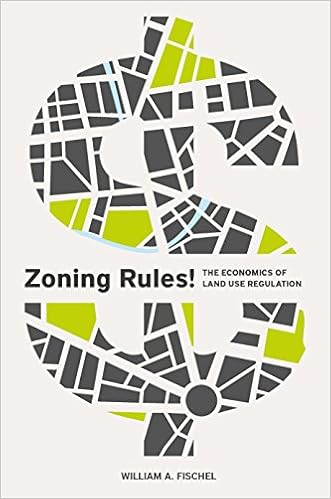
downtown railroad stations and docks to areas located further from the center of town. These transplanted uses put new homeowners in the situation where they may have paid a significant sum for the new home but were now faced with the possibility of an inconsistent land use which would drive down the value of the property. In order to control that possibility, zoning “spread like wildfire” across the United States. Fischel at 170-178.

The book has a number of interesting observations along those lines. Another one, which may not be of such general interest to many land use practitioners, but which I was tremendously interested in because of the similarity of New Jersey statutory law with ours here in Tennessee, involves a bit of history from the Garden State. It is well known that New Jersey adopted a state constitutional amendment in 1927 specifically recognizing the validity of zoning and land use planning. The text of the amendment currently reads (it has been changed slightly over the years) as follows:
The Legislature may enact general laws under which municipalities, other than counties, may adopt zoning ordinances limiting and restricting to specified districts and regulating therein, buildings and structures, according to their construction, and the nature and extent of their use, and the nature and extent of the uses of land, and the exercise of such authority shall be deemed to be within the police power of the State. Such laws shall be subject to repeal or alteration by the Legislature.
New Jersey State Constitution, 1947, Article IV, Section VI, ¶ 2.

But what I did not know is that in the years leading up to the constitutional amendment, including 1927 itself, the New Jersey courts emphatically resisted local land use controls, particularly in so far as various land uses were permitted in some areas but not in others. Fischel cites the example of the Oxford Construction Company v City of Orange, 137 A. 545 (NJ 1927) in which the construction company applied for a permit to allow the construction of four 5 story brick apartment houses. The property however was located in a zoning district which was principally for single-family residential use. The lower court case was decided in May 1926, Oxford Construction Company v City of Orange, 4 NJ Misc. 515 (NJL 1926), just before the November 1926 decision of the United States Supreme Court in Euclid v Ambler Realty 272 US 365 (1926). The lower court, citing numerous examples from the Court of Errors and Appeals, concluded that “the attempt to exclude apartment houses from a residential zone is a question which, standing alone, has been met in the various zoning cases and decided adversely to the contention of the [city]. There is no basis for the refusal on this ground of the building …  inspector of Orange to grant a building permit.” Id. at 517.

Once the decision of the US Supreme Court was handed down in Euclid however, one would have felt that on the appeal to the New Jersey Court of Errors and Appeals, that the High Court would soften its stance on the invalidity of such use restrictions. It did not. Instead, the court distinguished Euclid in its May 1927 opinion by pointing out that the US Supreme Court had restricted its opinion such that if
the provisions set forth in the [Euclid] ordinance under review should come to be concretely applied to particular premises, or to particular conditions, or to be considered in connection with specific complaints, some of them, or even many of them, might be found to be clearly arbitrary and unreasonable. Having so stated, then pointed out that the ambler Realty Company did not base its right to the relief prayed for upon the ground of a present infringement upon or denial of a specific right but upon the broad ground that the mere existence and threatened enforcement of the ordinance constitute a present and irreparable injury, and then held that the ordinance, in its general scope and dominant features, was so far as its provisions were involved in the case before the court, was a valid exercise of the police power, and left other provisions to be dealt with as the cases arise directly involving them.
The New Jersey Court was not swayed by the decision in Euclid.

That set the stage for the constitutional amendment in September of that same year. The prevailing powers in the state lost no time in adopting the amendment previously quoted, which in effect overturned the decision of the New Jersey courts in the Oxford Construction Company case. “ ... [M]unicipalities ... may adopt zoning ordinances limiting and restricting to specified districts and regulating therein, buildings and structures, according to their construction, and the nature and extent of their use, and the nature and extent of the uses of land, and the exercise of such authority shall be deemed to be within the police power of the State ...”  There are very few states in the country with a constitutional amendment which specifically provides that zoning and land use regulations are within the police power the state. But given the decisions of the New Jersey courts prior to that time, the constitutional amendment was obviously necessary.

Finally, in October 1927, the court had still not given up. In Robert Realty Co. V City of Orange, 139 A. 54 (NJL 1927), the New Jersey Court of Errors and Appeals yet again reaffirmed its old position:

This appeal brings up for review a judgment of the Supreme Court, directing the issuance of a peremptory writ of mandamus, compelling the granting by the municipal authorities of the city of Orange of a permit to the respondent, Robert Realty Company, authorizing it to erect three apartment houses upon a plot of land owned by it within the municipal limits. The sole ground upon which the appeal is rested is that the zoning ordinance of the city prohibits the erection of apartment houses on the respondent's plot; and that such ordinance is a valid exercise of the police power. The argument in support of the appellants' contention is identical with that which was submitted on their behalf in the case of Oxford Construction Co. v. City of Orange et al., 137 A. 545 (not yet officially reported), wherein the same question was presented. For the reasons stated in the cited case, the judgment under review will be affirmed.

But the court did acknowledge the constitutional amendment:
We deem it proper to point out that the judgment now before us was rendered some nine months prior to the adoption by the people of our state of the amendment to our Constitution, which declares that zoning ordinances similar to that involved in the present case shall hereafter, when legally adopted, be deemed to be within the police power of the state; and that, consequently, its validity is not affected by the subsequent change in our fundamental law.
Robert Realty Co. v. City of Orange, 103 N.J.L. 711, 712, 139 A. 54, 54-55 (1927).

And in something of a humorous postscript to this series of events, the New Jersey Court once again cited the Oxford Construction Company case in a decision in 1929 as follows:

There is nothing in the record to rebut the presumption that the ordinance is a reasonable exercise of the police power. Oxford Construction Co. v. Orange, 103 N. J. Law, 355, 137 A. 545.

Robert L. Evans, Inc. v. Williams, 148 A. 206, 206 (N.J. Sup. Ct. 1929). In the Evans case, the application by the property owner to require the issuance of a building permit for a use which was in violation of the zoning regulations was denied. Finally, based on the constitutional amendment, the New Jersey Court bowed to the constitutional imperative.

In any event, the Fischel book is very interesting and well worth reading. I have not yet finished the entire book, but look forward to continuing my reading.


Here’s a quick timeline of the events in New Jersey:

May 1926   Lower Court Opinion in Oxford Construction Company
                   (can't keep apt out of single-family area)
Nov 1926    US Supreme Court decides Euclid v Ambler Realty
May 1927   Court of Errors and Appeals affirms lower court in Oxford Construction
Sept 1927   NJ Constitutional Amendment relating to zoning and land use planning
Oct   1927   Court of Errors and Appeals decision in Robert Realty Co.
                    (can't keep apt out of single-family area)
Dec 1929    Court of Errors and Appeals decision in Robert Evans, Inc. v. Williams
                    (Separation of land uses is constitutionally valid)

Thursday, February 18, 2016

Can a Planning Commission Recommendation be appealed?

Last fall, Historic Sylvan Park Inc., sued Metro Nashville by way of a common law writ of certiorari, seeking to appeal a decision of the Metro Planning commission recommending against the extension of a historic zoning district in that neighborhood. The residents of Sylvan Park argued that the negative recommendation of the Planning Commission results in a requirement that a two thirds majority of the Metropolitan Council past the proposed zoning change pursuant to §18.02 of the Metropolitan Charter. The residents argued that because there’s no other mechanism by which to appeal the two thirds voting requirement, the Planning Commission decision was a final order subject to appeal by certiorari.

The Tennessee Court of Appeals did not agree. The court cited back to one of mild cases, Family Golf v Metro Nashville, 964 S.W. 2d 254, 259 (Tenn. App. 1997), which explained:
We view §18.02 as clear confirmation of the important advisory role of the Metropolitan Planning Commission plays in the control of the use of land Nashville. By requiring a super-majority of the Metropolitan Council to override the planning commission’s disapproval of a proposed zoning change, the Charter Commission intended to protect against random or ad hoc zoning and to ensure that the Metropolitan Council takes the carefully crafted general plan seriously.
964 S.W. 2d at 259. The important point here is this: a decision to extend the zoning district is a legislative decision made by the Metropolitan Council, with a recommendation from the Planning Commission. But that does not make the Planning Commission decision an administrative or judicial decision subject to review by the common law writ of certiorari; in fact, a zoning change application such as this can only be challenged by declaratory judgment. Fallin v Knox County, 656 SW 2d 338 (Tenn. 1983). The recommendation by the Planning Commission, both here in Nashville and across the state of Tennessee, is simply a part of the legislative process, not subject to review by means of the common law writ.

The Court of Appeals affirmed the decision of the trial court dismissing the case.